Wool. In summer. Hear me out.
It sounds like the worst possible fabric for a hot night. A randomised sleep trial at 30°C found the opposite.
- 100 night trial
- Free standard shipping
- 100% merino wool · 150 GSM
- Silicone and PFAS free
I assumed wool was a winter fibre. Heavy jumpers, scratchy socks, something you put away in April. If you had told me to sleep in it through a humid July, I would have laughed.
Then I looked at what had actually been tested. Not marketing, not a brand study. A randomised trial where adults slept in cotton, polyester and merino at 30°C, with monitoring on, and the results were published in a sleep journal.
Wool came out ahead. Not by hours, by minutes, and more clearly in older sleepers. But it came out ahead in exactly the conditions where I would have bet against it. So I kept reading.
Why the fibre everyone gets wrong works
Cotton is a sponge. It pulls sweat off your skin and then holds it there, a damp layer pressed against you for the rest of the night.
A wet layer does two things. It stops heat leaving your body, and when the room cools it chills you. So you swing between hot and cold.
Merino works differently. The fibre takes up moisture as vapour, inside its core, before it collects as liquid on the skin. The surface stays dry to the touch.
The fibre also releases heat when you run warm and holds it when you cool. It works in both directions, which is why merino is worn in desert heat as well as snow.
Ultrafine is the part that matters for sleep. Coarse wool prickles because thick fibres press into the skin. Our merino is under 17.5 micron, fine enough to bend instead.
Why the fibre you sleep in changes how hot you get, with the research and its limits. One email, no discount codes.
The questions everyone asks
HADAL makes one thing: a short sleep set in 100% ultrafine merino wool at 150 GSM. It is lightweight, breathable and made for warm nights. Thermocline adds xylitol cooling when moisture appears.
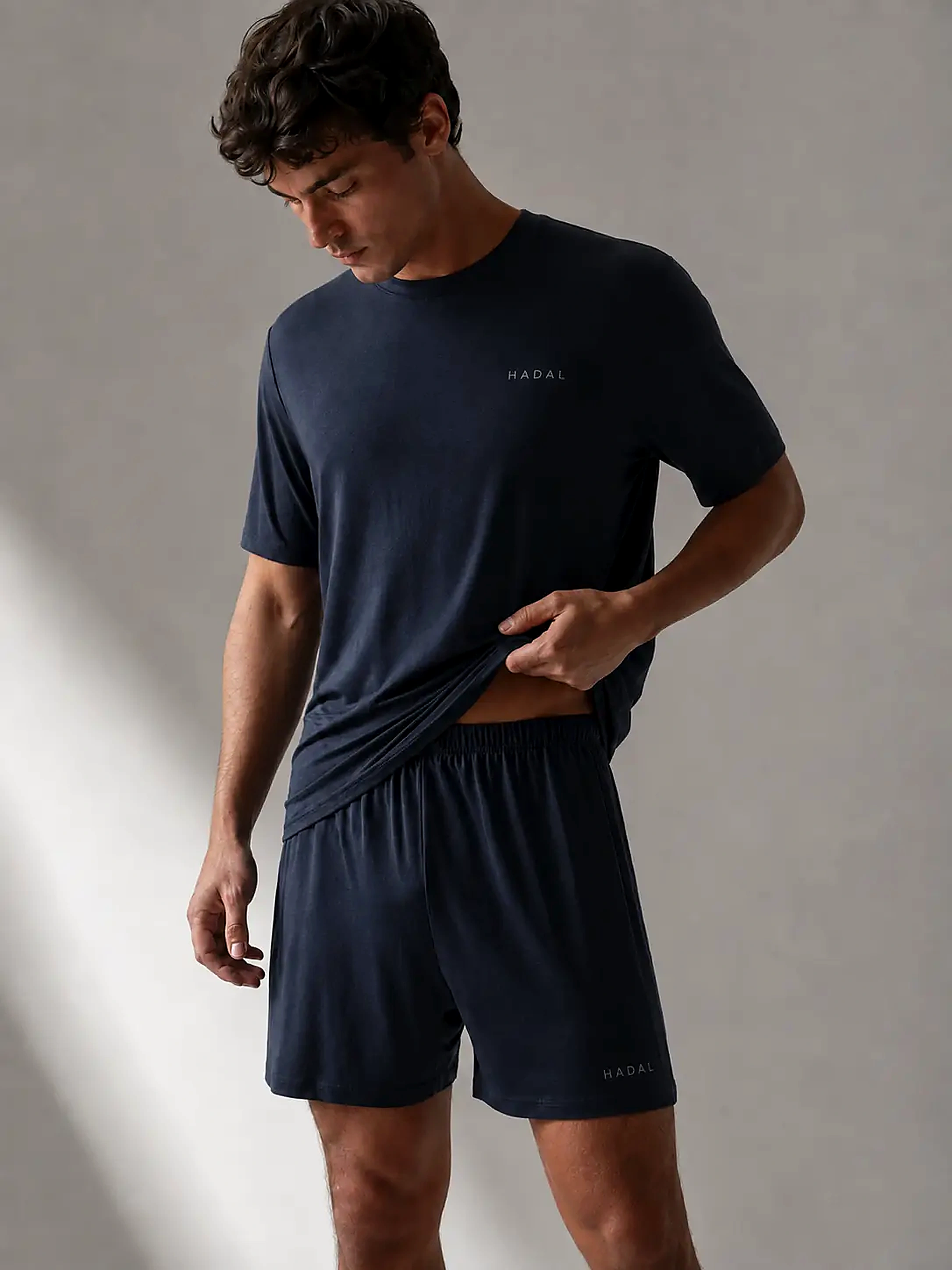 Worn
WornSleep Set
Shorts + Top
100% ULTRAFINE MERINO WOOL · 150 GSM
$298 for 2 sets, $149 a set. Each set worn for three years of nights is 14 cents a night.
Pure merino. Lightweight cooling. Nothing synthetic.
The set is made from 100% ultrafine merino wool in a breathable 150 GSM knit. Merino naturally manages heat, moisture and odour. Our proprietary Thermocline finish adds xylitol, designed to draw heat when moisture appears, with bio ceramic minerals that interact with body heat at the fabric surface.
One to wear, one in the wash.
Thinking wool sounds too warm for a hot night? Read the 2019 trial.
· 100% ultrafine merino wool, 150 GSM. No polyester, elastane or nylon.
· Free standard shipping in recycled packaging.
· 100 Night Trial. Full refund, worn or washed.
· Silicone free, PFAS free, formaldehyde free, no optical brighteners.
· Non mulesed merino, traceable to source.
Sleep in it for 100 nights.
If it is not right, send it back worn or washed and we refund you in full. Size exchanges are free.
Trust the evidence.
Sleep in it for up to 100 nights. If it is not right, we refund you in full, worn or washed.
Read the terms →Merino sleepwear has been tested against cotton and polyester in peer reviewed trials, including at 30°C. We show the numbers and their limits.
See the evidence →100% ultrafine merino wool at 150 GSM. Non mulesed, chlorine free. No silicone, PFAS, formaldehyde, optical brighteners or polyester.
Want the long-sleeve set instead?
We launched with the short set. A long-sleeve top and pants version is in development. Tell us and we will let you know first, and it will help us decide how many to make.
Wool is not the intuitive choice for a warm night. It is the tested one.
Most people assume wool is a winter fibre. That assumption has been tested directly, under warm conditions, with electrodes on. Here is what the research found, stated exactly as it was published, including its limits.
At 30°C and 50% humidity, 36 adults aged 50 to 70 slept four monitored nights each in cotton, polyester and merino wool sleepwear. Sleep onset was shortest in wool: 16.0 minutes, against 18.2 for polyester and 18.5 for cotton. Among participants aged 65 and over the gap widened to 12.4 minutes in wool against 21.6 in polyester and 26.7 in cotton.
Chow, Shin, Mahar, Halaki & Ireland (2019). Nature and Science of Sleep, 11, 167 to 178.
Read the studyA review of the sleepwear and bedding literature concluded that significant sleep benefits were observed with wool compared with cotton, including shortened sleep onset in young adults in cooler conditions and in older adults in warmer conditions.
Li et al. (2024). Journal of Sleep Research.
Read the reviewWhat this research does and does not show. These studies tested merino wool as a fibre. They did not test HADAL, and they did not test our Thermocline finish. The 2019 study was funded by Australian Wool Innovation. Its participants were aged 50 to 70, so the largest effects were seen in an older group than most of our customers. Across the whole sample the difference in sleep onset was a matter of minutes, not hours. We are running our own trial with sleep tracker data from HADAL wearers and we will publish the results here, whatever they show.